Skip to content
CalcBelt

Concrete calculator

Enter the size of your slab, footing or hole to get the cubic yards to order, the number of premixed bags and a cost estimate.

Units
What are you pouring?
Size from

Decimals or feet and inches: 10' 6". Where to measure

4 in (10 cm) for patios and walks; 5 to 6 in for driveways that take trucks.

Identical slabs or footings.

%

Concrete producers advise 4 to 10%.

One cubic yard is 27 cubic feet, or about 0.76 m³. It takes 45 bags of 80 lb or 60 bags of 60 lb premixed concrete.

Concrete needed

1.36 cubic yards

36.7 cubic feet · 1.04 m³, including 10% extra

80 lb bags
62
60 lb bags
82
50 lb bags
98
40 lb bags
123

Cost estimate

per cubic yard

Ready-mix: $204 for 1.36 cu yd

Typical US price $120 to $180 per cubic yard (HomeGuide, LawnStarter, October 2026). Orders under a full truck usually add a short-load fee.

per bag

Bagged mix: $403 for 62 bags of 80 lb

Typical US price $6 to $10 per 80 lb bag (Home Depot, Ace Hardware, October 2026).

How it's calculated
  1. Volume = length × width × thickness = 10 ft × 10 ft × 4 in (0.33 ft) = 33.3 cu ft
  2. Add 10% for waste and uneven ground: 36.7 cu ft
  3. 36.7 cu ft ÷ 27 = 1.36 cubic yards
  4. An 80 lb bag makes about 0.6 cu ft: 36.7 ÷ 0.6 = 61.1, rounded up to 62 bags

Estimates use manufacturer data sheets and industry guides (sources). Check local codes and your supplier's figures before you order.

How to use the concrete calculator

  1. Choose a slab, patio or footing, or a round column or post hole.
  2. Enter the measurements, or choose Known area to type a slab's square footage. You can type decimals or feet and inches, such as 10' 6".
  3. Set the thickness: 4 in for patios and walks, 5 to 6 in for driveways that carry trucks.
  4. Keep the 10% extra unless your forms are exact and the ground is perfectly level.
  5. Read the cubic yards to order ready-mix, or the number of bags for a small pour.

How to calculate concrete

Concrete is sold by volume, so the job is to find the volume of the space you’re filling. For a slab, footing or patio, multiply the three measurements in feet, then divide by 27 to get cubic yards:

Cubic yards = length (ft) × width (ft) × thickness (ft) ÷ 27

Thickness is usually measured in inches, so divide it by 12 first: 4 in is 0.333 ft, 6 in is 0.5 ft.

Example: a 12 × 16 ft patio, 4 in thick, is 12 × 16 × 0.333 = 64 cubic feet, or 2.37 cubic yards. Add 10% for waste and you need about 2.61 cubic yards, or 118 bags of 80 lb mix.

For a round column, sonotube or post hole, use the area of a circle instead:

Cubic feet = 3.1416 × (diameter ÷ 2)² × depth

A 12 in tube 4 ft deep holds 3.14 cubic feet, which is 6 bags of 80 lb mix.
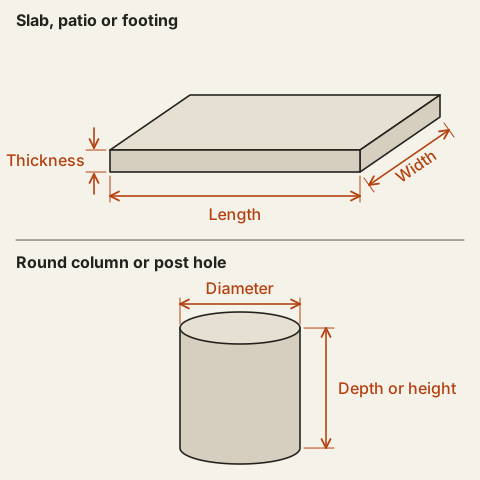
Concrete calculator diagram: a slab, patio or footing measured by its length, width and thickness, and a round column or post hole measured by its diameter and its depth or height.
Where to measure: length, width and thickness for a slab, patio or footing; diameter and depth for a round column or post hole.

Bags per cubic yard

Premixed bags list their yield on the back. These are Quikrete’s published yields; Sakrete’s standard mix gives the same figures at 40, 60 and 80 lb.

Bag size Yield per bag Bags per cubic yard Bags per m³
40 lb (18 kg) 0.30 cu ft 90 118
50 lb (23 kg) 0.375 cu ft 72 95
60 lb (27 kg) 0.45 cu ft 60 79
80 lb (36 kg) 0.60 cu ft 45 59

The calculator always rounds up to whole bags, as Quikrete’s own calculator does.

How thick to pour

Project Thickness
Sidewalks, patios and small slabs At least 4 in (100 mm)
Driveway for passenger cars only At least 4 in (100 mm); 5 in gives more margin
Driveway for trucks or RVs 5 to 6 in (125 to 150 mm)

Quikrete’s slab instructions put 3 to 4 in of gravel under a patio. Cut or tool control joints so the slab cracks where you want it to: NRMCA puts the maximum spacing at 24 to 36 times the slab thickness, which is 8 to 12 ft for a 4 in slab.

Bags or ready-mix

Bags make sense for post holes, steps, small pads and repairs. For more than about a cubic yard, mixing 45 or more heavy bags by hand is slow, and a ready-mix truck delivers it all at once. Ask the supplier about their minimum order, short-load fees and how close the truck can get to your forms.

For the gravel base under a slab, use the gravel calculator. The fence calculator counts the bags for post holes along a fence line, and the stair calculator works out the risers and run for concrete steps.

Questions and answers

How much concrete do I need?

About 1 cubic yard for every 81 sq ft of slab at 4 in thick, plus 10% for waste. In general, multiply length × width × thickness in feet and divide by 27 for cubic yards. A 12 × 12 ft slab at 4 in is 1.78 cubic yards, or 1.96 with the extra: 88 bags of 80 lb.

How much is a yard of concrete?

About $150 delivered for ready-mix, with most prices between $120 and $180 per cubic yard (HomeGuide, LawnStarter, 2026). Mixing a yard from bags takes 45 bags of 80 lb, about $290 at $6.50 a bag. Orders below the supplier's minimum load add a short-load fee.

How many bags of concrete are in a yard?

45 bags of 80 lb, 60 bags of 60 lb, 72 bags of 50 lb or 90 bags of 40 lb. That follows from Quikrete's yields of 0.60, 0.45, 0.375 and 0.30 cubic feet per bag, since a cubic yard is 27 cubic feet. Sakrete's standard mix yields the same at 40, 60 and 80 lb.

How much concrete do I need for a 10 × 10 slab?

At 4 inches thick, a 10 × 10 ft slab is 33.3 cubic feet, or 1.23 cubic yards. With 10% extra, plan on about 1.36 cubic yards: 62 bags of 80 lb, or a small ready-mix load.

How much extra concrete should I order?

The National Ready Mixed Concrete Association recommends ordering 4 to 10% more than the plan dimensions to cover waste, over-excavation and uneven ground. Sakrete says to add 10%, which is this calculator's default.

How thick should a concrete slab be?

Quikrete calls for at least 4 inches for sidewalks and small slabs, 4 inches for driveways used only by passenger cars, and 5 to 6 inches where trucks will drive. Footings and driveway aprons must follow your local building code.

Should I use bags or ready-mix?

Bags suit small pours such as post holes, steps and pads. Above about a cubic yard, ready-mix delivery saves a lot of mixing, though suppliers add a short-load fee on small orders, often $30 to $60 per yard under their minimum (HomeGuide).

How much does a concrete slab cost?

Cost guides put a plain 4-inch slab at about $4 to $8 per square foot installed (Angi, Forbes Home), with patios up to about $12 (HomeGuide). Ready-mix alone runs about $120 to $180 per cubic yard delivered, and an 80 lb bag about $6.50 to $10.

How many bags of concrete do I need for a 4 × 8 slab?

At 4 in thick, a 4 × 8 ft slab is 10.67 cu ft, or 11.73 cu ft with 10% extra. That's 20 bags of 80 lb (0.60 cu ft each), 27 bags of 60 lb or 32 bags of 50 lb, using Quikrete's yields.

How much area does a bag of concrete cover?

At 4 in thick, an 80 lb bag of Quikrete Concrete Mix (0.60 cu ft) covers 1.8 sq ft, a 60 lb bag (0.45 cu ft) 1.35 sq ft and a 50 lb bag (0.375 cu ft) about 1.1 sq ft. At 8 in thick each bag covers half as much.

Sources

Figures checked October 2026.