Skip to content
CalcBelt

Raised bed soil calculator

Add up your raised beds to see how many cubic feet, cubic yards or bags of soil fill them, and how much topsoil and compost go into the mix.

Units

Start from

Bed
Shape

Measure inside the frame. Where to measure

Most beds are 6 to 12 in deep. On paving, tomatoes need 12 to 24 in.

%

Compost-rich mixes settle; 20% is a common allowance.

By volume. Source: Illinois and Maryland Extension.

Check the bag: sizes vary by brand.

Soil needed

38.4 cubic feet

1.42 cubic yards, with 20% extra for settling · 39 bags of 1 cu ft

Topsoil (50%)
19.2 cu ft0.71 cu yd · 20 bags of 1 cu ft
Compost (50%)
19.2 cu ft0.71 cu yd · 20 bags of 1 cu ft

Cost estimate

per cubic yard
per 1 cu ft bag

Both start blank: no two current cost guides price compost or a raised bed mix. Bulk topsoil alone runs $10 to $55 a cubic yard (HomeAdvisor, LawnLove).

How it's calculated
  1. Beds: 32 sq ft
  2. 32 sq ft × 12 in deep = 32 cu ft
  3. Add 20% for settling: 38.4 cu ft = 1.42 cu yd
  4. Mix: topsoil 50% = 19.2 cu ft, compost 50% = 19.2 cu ft
  5. Bags: 38.4 cu ft ÷ 1 cu ft = 38.4, rounded up to 39

Estimates use manufacturer data sheets and industry guides (sources). Check local codes and your supplier's figures before you order.

How to use the raised bed soil calculator

  1. Measure each bed inside the frame and enter its length and width, or pick Circle for a round bed. For several beds of the same size, set How many.
  2. Add another bed size for beds that differ, or start from a preset.
  3. Enter the soil depth: 6 to 12 in for most beds, deeper for tomatoes and squash.
  4. Pick a mix to see how much of each part to buy, and the bag size you'll buy it in.
  5. Read the cubic feet for bags or the cubic yards for a bulk order, then compare prices if you have them.

How to calculate soil for a raised bed

A raised bed is a box, so the soil it holds is its inside length × width × depth. Add an allowance for settling, since loose soil and compost sink once they’re watered:

Cubic feet = length (ft) × width (ft) × depth (in) ÷ 12 × (1 + settling %)
Cubic yards = cubic feet ÷ 27
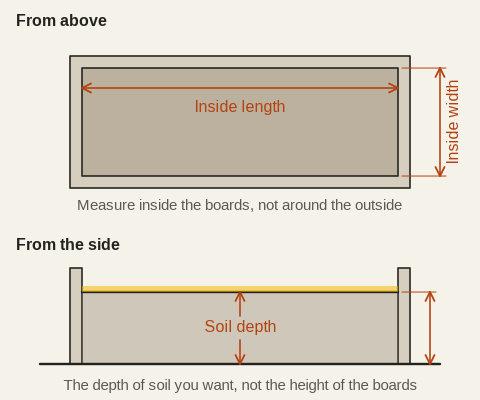
Where to measure a raised bed for soil: inside length, inside width and the soil depth
Where to measure: inside the frame, and use the depth of soil you want, not the height of the boards.

Example: two beds of 8 × 4 ft, filled 12 in deep, hold 2 × 32 = 64 cubic feet. With 20% extra that’s 76.8 cubic feet, or 2.84 cubic yards: 77 bags of 1 cubic foot. In equal parts topsoil and compost, buy 38.4 cubic feet of each.

For a round bed, the area is 3.1416 × radius². A bed 4 ft across has a 2 ft radius: 12.6 sq ft, so 12.6 cubic feet at 12 in before settling.

Soil by bed size

With 20% extra for settling, the calculator’s default:

Bed (inside) 6 in deep 8 in deep 12 in deep 18 in deep
4 × 4 ft 9.6 cu ft 12.8 cu ft 19.2 cu ft 28.8 cu ft
8 × 4 ft 19.2 cu ft 25.6 cu ft 38.4 cu ft (1.42 cu yd) 57.6 cu ft (2.13 cu yd)
10 × 4 ft 24 cu ft 32 cu ft 48 cu ft (1.78 cu yd) 72 cu ft (2.67 cu yd)
12 × 4 ft 28.8 cu ft 38.4 cu ft 57.6 cu ft (2.13 cu yd) 86.4 cu ft (3.2 cu yd)

What to fill it with

Extension services suggest mixing compost into the soil rather than filling a bed with topsoil alone:

Mix, by volume Source When
Compost and topsoil, equal parts University of Illinois Extension; University of Maryland Extension Most beds
2 parts topsoil, 1 part compost University of Maryland Extension A bed on a lawn
Compost and soilless growing mix, equal parts University of Maryland Extension On a lawn, or on paving or hard, compacted soil
60% topsoil, 30% compost, 10% potting mix Gardener’s Supply Its own recommendation

Maryland adds that a bed made only of compost or soilless mix dries out faster than one with mineral soil, and that topsoil can make up to 20% of a bed on paving that’s at least 16 in deep. Buy a little over each part’s share, since bag sizes rarely match.

Bags or bulk

Bag sizes vary by brand, so the calculator counts bags at the size you pick from the label (cubic feet, or liters in metric). A cubic yard is 27 cubic feet: if your beds take a yard or more, get a bulk quote with delivery and compare it with the bag total. Bulk topsoil runs about $10 to $55 a cubic yard (HomeAdvisor, LawnLove; some prices include delivery); compost and blended raised bed mixes have no shared figure in the cost guides, so type your local prices to compare.

For in-ground beds, lawns and fill, use the topsoil calculator; to cover the beds afterwards, the mulch calculator works out the bags at 2 to 3 in.

Questions and answers

How do I figure out how much soil I need for a raised bed?

Multiply the inside length × width × depth, all in feet, for the cubic feet, then add about 20% for settling. An 8 × 4 ft bed 1 ft deep holds 32 cubic feet; with 20% extra that's 38.4 cubic feet, or 1.42 cubic yards. Divide cubic feet by 27 for cubic yards.

How much soil do I need for a 4 × 8 raised bed?

About 38 cubic feet (1.4 cubic yards) at 12 in deep, with 20% extra for settling: 39 bags of 1 cu ft. At 6 in deep it's half that, about 19 cubic feet, and at 18 in about 58 cubic feet.

How much soil do I need for a 4 × 4 raised bed?

About 19 cubic feet at 12 in deep with 20% extra, or about 10 cubic feet at 6 in, which University of Tennessee Extension says is enough for leafy greens. That's 20 or 10 bags of 1 cu ft.

How many bags of soil do I need for a raised bed?

39 bags of 1 cu ft or 52 bags of 0.75 cu ft for an 8 × 4 ft bed 12 in deep, with 20% extra. In general, divide the cubic feet to fill by the bag size on the label and round up.

What is the best soil mix for a raised bed?

University of Illinois Extension suggests equal parts compost and garden soil or topsoil. University of Maryland Extension gives compost and topsoil at 1 to 2 or 1 to 1 for a bed on a lawn, and compost with a soilless growing mix 1 to 1 for a bed on paving. Gardener's Supply recommends 60% topsoil, 30% compost and 10% potting mix. The calculator splits the total for each of these.

How deep should a raised bed be?

6 to 12 inches for most beds (University of Illinois Extension); University of Tennessee Extension says 4 to 6 inches is enough for leafy greens. For a bed on paving or hard, compacted soil, the University of Maryland suggests at least 8 inches for leafy greens, beans and cucumbers, and 12 to 24 inches for tomatoes, peppers and squash.

How much extra soil should I buy for settling?

About 20% for a compost-rich mix, the calculator's default. Hello Gravel says fresh topsoil often loses 10 to 15% of its volume in the first weeks, and Mulch Mound expects 15 to 20%, more with a lot of compost. Illinois Extension notes beds keep settling as the compost breaks down, so top them up each year.

How do I convert square feet to cubic yards of soil?

Multiply the square feet by the depth in inches, divide by 12 for cubic feet, then by 27 for cubic yards. 100 sq ft at 6 in deep is 50 cubic feet, or 1.85 cubic yards, before settling.

How many 25 L bags of soil are in 1 m³?

40 bags: a cubic meter is 1,000 liters, and 1,000 ÷ 25 = 40. Switch the calculator to metric to count 25, 40, 50 or 70 L bags.

How many cubic feet are in a cubic yard of soil?

27 cubic feet (3 × 3 × 3 ft). One cubic yard fills an 8 × 4 ft bed about 10 inches deep before settling.

Sources

Figures checked October 2026.