How to calculate wallpaper
Wall area = wall width × height − 20 sq ft per door and window
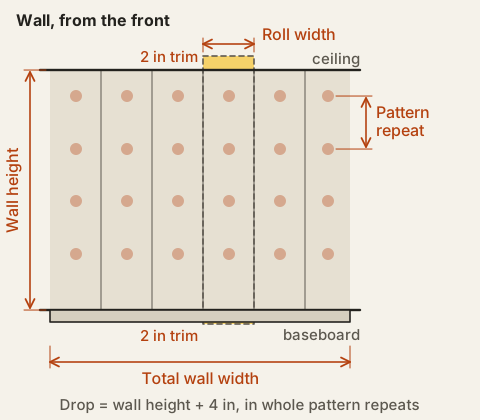
Drop = height + 4 in, rounded up to whole pattern repeats
Drops per roll = roll length ÷ drop, rounded down
Usable per roll = drops per roll × roll width × height
Rolls = wall area ÷ usable per roll, rounded up
Example: a 12 × 14 ft bedroom with 8 ft walls, one door, two windows and a 21 in pattern repeat, papered with 20.5 in × 33 ft double rolls.
- Walls: 2 × (12 + 14) × 8 = 416 sq ft, less 3 × 20 = 356 sq ft
- Drop: 96 + 4 = 100 in, rounded up to five 21 in repeats = 105 in
- Drops per roll: 396 in ÷ 105 = 3.8, so 3
- Usable per roll: 3 × 20.5 in × 8 ft = 41 sq ft
- Rolls: 356 ÷ 41 = 8.7, so 9 double rolls
- Hanging at a typical $4.50 per sq ft: about $1,600
Why the calculator counts whole drops
A roll can’t be used to the last inch: each drop is cut to the wall’s height plus trim, and what’s left at the end of the roll may be too short for another drop. A 33 ft roll gives three drops on an 8 ft wall, using 300 of its 396 inches. Counting whole drops per roll is closer to how the paper is cut than dividing by the 56 sq ft on the label, and it can come out above Sherwin-Williams’ rule of thumb of about 25 usable sq ft per single roll.
Pattern repeat
Each drop has to line up with the one beside it, so a pattern with a long repeat wastes more at the top or bottom of every drop. The calculator rounds each drop up to a whole number of repeats. With a 21 in repeat on 8 ft walls, a drop grows from 100 in to 105 in; on 9 ft walls, from 112 in to 126 in.
Before you buy
Buy all the rolls from the same run or lot number, and an extra roll for patches, as Sherwin-Williams suggests. To paint the other walls instead, the paint calculator uses the same room measurements. Removing old wallpaper costs extra.