Skip to content
CalcBelt

Insulation calculator

Pick your climate zone and enter the attic, floor or wall area to get ENERGY STAR's recommended R-value and the blown-in bags, batts or spray foam to reach it.

Units
Where
Shape

Measure the floor of the attic or room below, wall to wall. Where to measure

Find yours on ENERGY STAR's map.

Insulation already there

Insulation needed

25 bags

To add R-49 (R-60 in total) over 1,000 sq ft

Depth
17 inSettling is negligible (Owens Corning)
Coverage
25 per 1,000 sq ftR-49, Owens Corning AttiCat chart, 27.5 lb bags
R-value added
R-49
  • ENERGY STAR's recommended levels for upgrading existing homes, based on the 2021 IECC. Local code may require different values for new construction or permitted work.

Cost estimate

per sq ft

Installed: $2,000 for 1,000 sq ft (range $900 to $3,800)

Typical US price $0.90 to $3.80 per sq ft (HomeGuide, Fixr, October 2026). Materials and labor.

How it's calculated
  1. ENERGY STAR adds R-49 to an attic with 3 to 4 in in zone 4c, 5 or 6 (R-60 in total)
  2. Area: 1,000 sq ft
  3. Chart row R-49: 25 bags per 1,000 sq ft, 17 in thick
  4. 1,000 sq ft ÷ 1,000 × 25 = 25, rounded up to 25 bags

Estimates use manufacturer data sheets and industry guides (sources). Check local codes and your supplier's figures before you order.

How to use the insulation calculator

  1. Pick where you're insulating: the attic floor, a floor over a crawl space, or walls.
  2. Find your climate zone on ENERGY STAR's map and say how much insulation the attic already has.
  3. Enter the area and pick the insulation: blown-in fiberglass or cellulose, batts, or spray foam.
  4. Read the bags, batts or foam thickness, and check the installed price.

How to calculate attic insulation

R-value to add = ENERGY STAR's level for your zone − what's there now
Blown-in bags = area ÷ 1,000 × bags per 1,000 sq ft (from the bag's chart)
Batts = area ÷ area of one batt, for each layer
Spray foam thickness = R-value ÷ R per inch

Example: a 1,000 sq ft attic in zone 5 that already has 3 to 4 in of insulation.

  • ENERGY STAR: add R-49 (R-60 in total)
  • Blown fiberglass, Owens Corning AttiCat: 25 bags per 1,000 sq ft at R-49, so 25 bags, 17 in deep
  • Or blown cellulose, GreenFiber: 70.8 bags per 1,000 sq ft, so 71 bags, 13.3 in settled (blown in at 14.3 in)
  • Or batts: R-30 between the joists plus R-19 across them, 1,000 sq ft of each
  • Installed blown-in at a typical $2 per sq ft: about $2,000
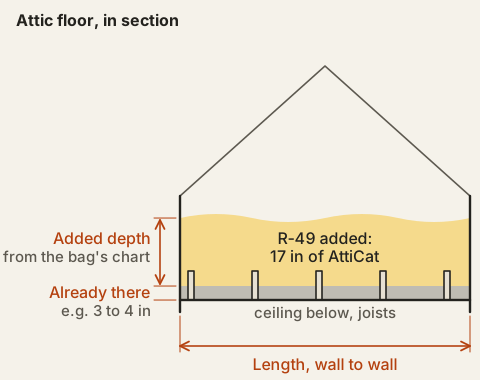
Insulation calculator diagram: an attic seen in section with the ceiling joists, an existing layer of 3 to 4 inches of insulation, and new blown-in insulation on top reaching the depth for the recommended R-value, with the attic floor's length measured wall to wall.
Where to measure: the attic floor, wall to wall, and the depth of insulation already there. The new layer goes on top, to the depth on the bag's chart.
Zone Attic with no insulation Attic with 3 to 4 in, add Floor
1 R-30 R-25 R-13
2 R-49 R-38 R-13
3 R-49 R-38 R-19
4A and 4B R-60 R-49 R-19
4C, 5 and 6 R-60 R-49 R-30
7 and 8 R-60 R-49 R-38

These are ENERGY STAR’s recommended levels for upgrading existing wood-framed homes, based on the 2021 IECC. Local code may require different values for new construction or permitted work. For walls, ENERGY STAR suggests blowing insulation into empty cavities and adding insulated sheathing when the siding comes off; the calculator covers batts for open walls only.

Coverage charts

Blown-in insulation is sold by the bag, and its maker publishes a chart of R-values with the minimum bags per 1,000 sq ft and the minimum thickness. GreenFiber’s chart says both have to be met to reach the R-value. The calculator uses two of them:

R-value AttiCat bags Depth Cellulose bags Depth
R-30 14.6 10.75 in 38.6 8.3 in
R-38 19 13.5 in 52.6 10.4 in
R-49 25 17 in 70.8 13.3 in
R-60 31.5 20.5 in 86 16.1 in

Bags per 1,000 sq ft: Owens Corning AttiCat blown fiberglass and GreenFiber SANCTUARY cellulose. The cellulose depth is after settling.

If the R-value you need falls between two rows, the calculator takes the next one up. Other brands have their own charts, so check the bag you buy.

Batts and spray foam

R-values of stacked layers add up, so batts can reach high attic levels in two layers: R-30 + R-19 makes R-49 and R-30 + R-30 makes R-60. The calculator counts pieces in Owens Corning’s sizes (16 or 24 in wide for joists 16 or 24 in apart) and doesn’t subtract the framing, so you’ll have a few spare.

Spray foam is rated per inch: about R-3.6 for open-cell and R-6 for closed-cell (DOE Building America). Its price depends on the thickness, so the per-square-foot ranges in the cost box are rough. To size a room air conditioner, use the BTU calculator.

Questions and answers

How much insulation do I need in my attic?

R-30 to R-60 in total, depending on your climate zone. For an attic with no insulation, ENERGY STAR recommends R-30 in zone 1, R-49 in zones 2 and 3 and R-60 in zones 4 to 8. If it already has 3 to 4 in, add R-25 in zone 1, R-38 in zones 2 and 3, and R-49 in zones 4 to 8.

How many bags of blown-in insulation do I need?

Whatever the coverage chart on the bag says for your area and R-value. For 1,000 sq ft at R-49, Owens Corning's AttiCat chart calls for 25 bags of 27.5 lb, 17 in deep, and GreenFiber's cellulose chart 70.8 bags of 25 lb, 13.3 in deep once settled. The calculator reads the chart and rounds up.

How many inches of insulation is R-38?

About 13.5 in of blown fiberglass (Owens Corning AttiCat), 10.4 in of settled cellulose (GreenFiber), or one 12 1/4 in R-38 batt (Owens Corning). R-49 is 17 in of AttiCat or 13.3 in of cellulose; R-60 is 20.5 in or 16.1 in.

How much does attic insulation cost?

Blown-in attic insulation costs $0.90 to $2.40 per square foot installed, according to HomeGuide, and Fixr gives $1.65 to $3.80 for blown-in. By R-value, HomeGuide puts 1,000 sq ft at $840 to $1,500 for R-38 and $1,100 to $1,900 for R-49.

How much does spray foam insulation cost?

HomeGuide gives $1.50 to $3.50 per square foot for open-cell and $3 to $5 for closed-cell; HomeAdvisor $0.88 to $3.85 and $1.44 to $4.70. Neither states the thickness, which drives the price: HomeAdvisor's installed prices per board foot (1 sq ft, 1 in thick) are $0.60 to $1.60 for open-cell and $1.30 to $3.10 for closed-cell.

Can I add insulation on top of old insulation?

Yes: the DOE says the R-values of layers add up, so the calculator takes off what's already there. The DOE's insulation fact sheet also says not to put a vapor barrier between the old and new layers.

What climate zone am I in?

Find it on ENERGY STAR's map, on its recommended R-values page. The higher the zone number, the more attic insulation ENERGY STAR recommends: R-30 in zone 1 up to R-60 in zones 4 to 8.

Are these R-values required by code?

No. They're ENERGY STAR's recommended levels for upgrading existing homes, based on the 2021 IECC. Local code may require different values for new construction or permitted work, so check with your building department.

What R-value fits a 2 × 4 or 2 × 6 wall?

A 2 × 4 stud is 3 1/2 in deep, the thickness of Owens Corning's R-13 and R-15 batts. A 2 × 6 is 5 1/2 in deep, which fits its R-21 batt; its R-19 batt is 6 1/4 in thick.

Sources

Figures checked October 2026.