Skip to content
CalcBelt

Tile patterns and how much extra tile to buy

The four common tile patterns are straight (stacked), offset, diagonal and herringbone. The more cuts a pattern needs, the more extra tile to buy: about 10% for straight, 15% for diagonal and 20% for herringbone. Tiles longer than 15 in shouldn't be offset by more than a third.

Flooring & tile · Updated October 20, 2026 · Sources

What you'll need

  • The area to tile, measured (see the square footage guide)
  • Your tile's size and the joint width
  • The pattern you want
  • Spacers, grout and thinset (the calculator counts the grout and thinset)

Work out how much you need

The tile calculator, set up for this project. Change any number.

Units
Area to tile
Tile

Fractions work: 1/16, 1/8, 3/16.

Used for grout depth.

Layout and supplies
%

Keep a few spare tiles for repairs.

sq ft

On the box label.

Tiles needed

457 tiles

To cover 120 sq ft: 100 sq ft plus 20% extra

Grout
17.9 lb1 bag of 25 lb
Thinset mortar
2 bags50 lb bags, 63 sq ft each

Cost estimate

per sq ft

From the store label.

per sq ft

Labor: $1,050 (range $300 to $1,500)

Typical US prices $3 to $15 per sq ft (HomeAdvisor, This Old House, Fixr, October 2026); local prices vary. Large tiles, patterns and removing old floors cost more.

How it's calculated
  1. Area: 100 sq ft; add 20% for cuts and spares: 120 sq ft
  2. One tile plus its grout joint covers 0.26 sq ft
  3. 120 sq ft ÷ 0.26 sq ft = 456, rounded up to 457 tiles
  4. Grout (MAPEI's formula): joint length per area × joint width × depth × 1.6 kg/L, plus 10% = 17.9 lb

Step by step

  1. Choose the pattern

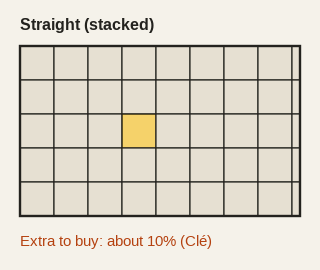
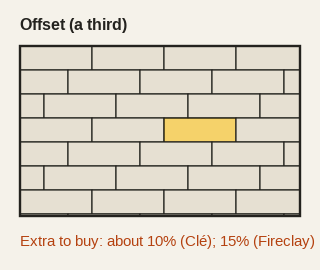
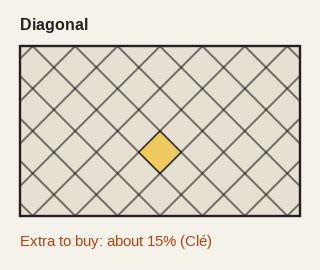
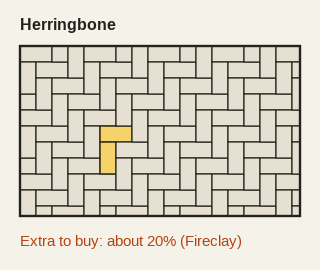
    Straight lays square or rectangular tiles in a grid with every joint lined up. Offset shifts each row along by part of a tile, like brickwork. Diagonal turns the grid 45° to the walls. Herringbone sets rectangular tiles at right angles to each other in a zigzag. The drawings below show each one.

  2. Check the offset for long tiles

    If the side being offset is longer than 15 in, the tile standard (ANSI A108.02, quoted by the Ceramic Tile Foundation) limits the offset to a third of the tile unless the tile maker says otherwise. A half offset puts the slightly curved middle of one tile next to the ends of the next, which causes lippage: uneven edges.

  3. Measure the area

    Multiply length × width for the floor or wall, split odd shapes into rectangles, and leave out areas under cabinets and tubs. Fireclay Tile advises having your installer check the measurements before you order.

  4. Add the extra for your pattern

    Clé Tile recommends about 10% extra and 15% for diagonal layouts; Fireclay suggests 15% for field tile such as subway and 20% for herringbone and other patterns with many cuts. Set the layout in the calculator and it adds the extra.

  5. Count the trim and the materials

    Fireclay reminds you to order trim for any exposed tile edge. The calculator also counts the bags of grout (from MAPEI's formula) and thinset for the area.

  6. Order everything at once

    Clé notes that tile batches vary slightly in shade, so buying all the tile, extra included, in one order keeps it from the same production run. Keep a few spare tiles for repairs.

The four patterns

Straight or stacked tile pattern: square tiles in a grid with every joint lined up, about 10 percent extra tile
Straight (stacked): the fewest cuts. About 10% extra.
Offset tile pattern: rectangular tiles with each row shifted by a third of a tile, about 10 to 15 percent extra tile
Offset by a third: the ANSI limit for tiles over 15 in, unless the tile maker says otherwise. About 10 to 15% extra.
Diagonal tile pattern: square tiles turned 45 degrees to the walls so every tile along the walls is cut, about 15 percent extra tile
Diagonal: every edge tile is cut. About 15% extra.
Herringbone tile pattern: rectangular tiles twice as long as wide, set at right angles in a zigzag, about 20 percent extra tile
Herringbone: rectangular tiles at right angles, many cuts. About 20% extra.
Pattern Extra to buy Source
Straight (stacked) about 10% Clé Tile
Offset about 10% (Clé); 15% for field tile (Fireclay) Clé Tile, Fireclay Tile
Diagonal about 15%; Clé says consider up to 25% Clé Tile
Herringbone about 20% Fireclay Tile
Chevron 20% in the calculator, the same as herringbone CalcBelt’s choice

Working out the tiles

Tiles = area × (1 + extra %) ÷ [(tile length + joint) × (tile width + joint) ÷ 144]
Lengths in inches, area in square feet

Example: a 10 × 10 ft floor (100 sq ft) in herringbone with 3 × 12 in tiles and 1/8 in joints. One tile and its joint cover 3.125 × 12.125 ÷ 144 = 0.263 sq ft. With 20% extra the floor takes 120 sq ft of tile: 120 ÷ 0.263 = 456.1, so 457 tiles. Laid straight, with 10% extra, the same floor takes 419.

The calculator above starts on this example; change the size, the joint and the pattern to match your tile.

Materials and how much

ItemHow much
TileArea × (1 + extra %) ÷ the area of one tile with its joint (the calculator)
GroutFrom the tile size, thickness and joint width (MAPEI's formula, in the calculator)
Thinset50 lb bags by trowel size: about 40 to 90 sq ft each (Custom Building Products, MAPEI)
Trim piecesThe length of every exposed tile edge

What it costs

ItemTypical US priceSource
Tile installed (ceramic)$11 to $39 per sq ft, $16.75 typicalThis Old House, Fixr
Installation labor only$3 to $15 per sq ft, $10.50 typicalHomeAdvisor, This Old House, Fixr

National averages; local prices vary, so get quotes.

Pin image for this guide: Tile patterns and how much extra tile to buy

Pin this guide

Save it to a Pinterest board for later, with the drawing.

Save to Pinterest

Common mistakes

  • Ordering the same extra for every pattern: herringbone needs about twice the straight-lay allowance.
  • Offsetting long tiles by half, which shows lippage; keep a third for tiles over 15 in (ANSI A108.02).
  • Buying the extra later, from a different batch that doesn't match (Clé).
  • Forgetting trim for exposed edges (Fireclay).
  • Leaving no spare tiles for future repairs.

Questions and answers

How much extra tile do I need for herringbone?

About 20% extra (Fireclay Tile), against about 10% for a straight lay (Clé Tile). Herringbone needs many more cuts at the edges. For a 100 sq ft floor in 3 × 12 in tiles with 1/8 in joints, that's 457 tiles.

How much extra tile for a diagonal layout?

About 15% (Clé Tile). Every tile along the walls is cut, and Clé also says to consider up to 25% extra for diagonal patterns, because of the cuts along walls and corners.

Should I offset tile by half or a third?

A third for tiles longer than 15 in on the offset side, unless the tile maker says otherwise. That's the ANSI A108.02 rule the Ceramic Tile Foundation quotes; a half offset lines up each tile's slightly high middle with its neighbors' ends and shows lippage.

What's the difference between herringbone and chevron?

In herringbone, rectangular tiles meet at right angles, with the end of one against the side of the next. In chevron, the tile ends are cut at an angle so the rows meet in a continuous point. Both take extra tile: the calculator uses 20% for either.

What is a straight or stacked tile pattern?

Tiles laid in a grid, with every joint in line both ways. It needs the fewest cuts, so about 10% extra is enough (Clé Tile).

Do patterns change how much grout I need?

Not much: grout depends on the joint length per square foot, which comes from the tile size and joint width, not the layout. The calculator uses MAPEI's formula with the tile's size, thickness and joint.

Sources